A 1968 VIN has 13 characters. Type one in, and the decoder reads it against the code tables on this page.
XS29J8B10000135 · An example built from the code tables on this page, not a real car's VIN: R/T, Hemi, 1968, Hamtramck, unit 100001. A real 1968 Charger VIN, decoded, is on our General Lee page.
The code table
Position
Meaning
X
Car line: Dodge Charger
P · S
Price class: Charger · Charger R/T
29
Body: 2-door sports hardtop
B · F · G · H · J · K · L
Engine (see the engine table)
8
Model year (1968)
A · B · C · D · E · F · G · R
Assembly plant (Dodge's code table)
100001 →
Sequential unit number
Where to find it: On a plate on the left top of the dash, visible through the windshield.35
Every conflict we found for 1968, and how we settled it. All rulings.
Open
1968 Charger production
Our ruling: Unresolved. We show 96,100, which Over-Drive and Wikipedia give alike; Over-Drive rounds to the hundred, so the true figure may be Consumer Guide's 96,108. Consumer Guide's other article gives 92,590, and no source explains the gap.
«For $3,506, the R/T came with the 375-bhp 440-cid four-barrel Magnum V-8»6one source
Settled
Was there a six-cylinder 1968 Charger?
Our ruling: Yes, from the middle of the model year. Wikipedia and Hagerty say so, and Over-Drive's own table has a six-cylinder row, against the «all V-8s» in its note.
What each source says (3)
«Some 96,100 Chargers and R/Ts were built during model year 1968, all V-8s»1one source
A 225 slant six replaced the 318 as standard in the middle of the model year23
A six-cylinder row (XP-29, I-6, $3,014) in the same table1one source
Settled
The size of the 1968–69 Charger
Our ruling: We use Dodge's own catalogs for both years: 208.0 × 76.6 × 53.2 inches. Wikipedia and Over-Drive give 76.7 for the width, and Over-Drive 207.0 for the 1969 length. For 1969 Over-Drive gives the height as 53.0 inches, or 53.5 with the 318.
What each source says (4)
208.0 long, 76.6 wide, 53.2 high (1968 and 1969 catalogs)78one source
Our ruling: Letters. The Poorman's Off Chassis Restoration site (tpocr.com) gives letters for 1968–69 and Hagerty calls the seventh character a letter; only one guide gives digits. The same guide gives T for Windsor in 1970, where two others give R.
What each source says (3)
Letters from 1968: A Lynch Road, B Hamtramck … R Windsor5one source
«the seventh letter designates the plant»3one source
The redesign found the buyers the fastback had missed. Hagerty says the Charger only found its audience once it traded the sloping roof for Coke-bottle bodywork, and Consumer Guide puts it with the equally new Pontiac GTO among the hottest cars around, although racing soon called for a fastback version again. About three quarters of 1968 Chargers had a vinyl top, by Hagerty's account. For collectors, Hagerty notes that the 1968 windshields leaked, rotting trunk floors and floor pans, and that with the fewest option combinations the 1968 is generally the most affordable of the 1968 to 1970 cars.312
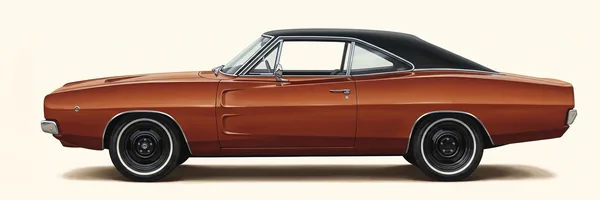
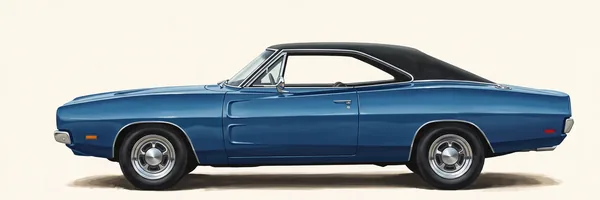
The 1968 Charger was all new, with coke-bottle styling by Richard Sias. The fastback was gone: a flying-buttress roof made the car look like one.29
Sales rose to about 96,100, six times the 1967 figure. The R/T, new this year, took nearly a fifth of them.123sources disagree
The 318 V8 was the standard engine until the middle of the model year, when a 225 slant six took its place.23
The story of the year
Bullitt and the Scat Pack
In the 1968 film Bullitt, a black Charger R/T 440 is chased through San Francisco by Steve McQueen's Mustang GT.24
The R/T, for Road/Track, came with the 440 Magnum; the only engine option was the 426 Hemi. It belonged to Dodge's «Scat Pack» with the Coronet R/T and the Dart GTS.246
The Scat Pack cars wore bumblebee stripes around the tail. On the Charger R/T they were standard, in red, white or black, and could be left off at no cost.24
How to spot a 1968
What tells it apart from a 1967.
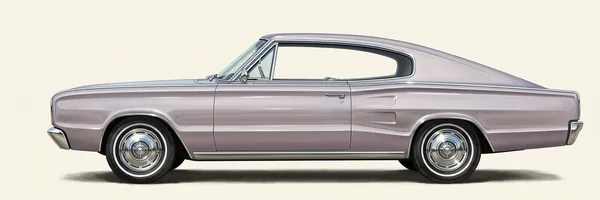
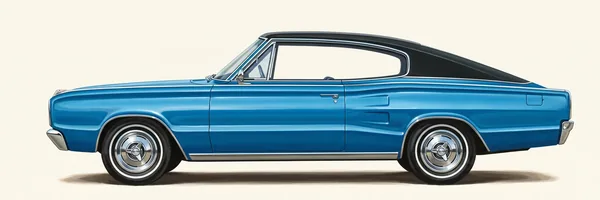
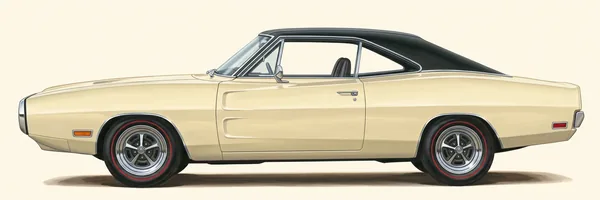
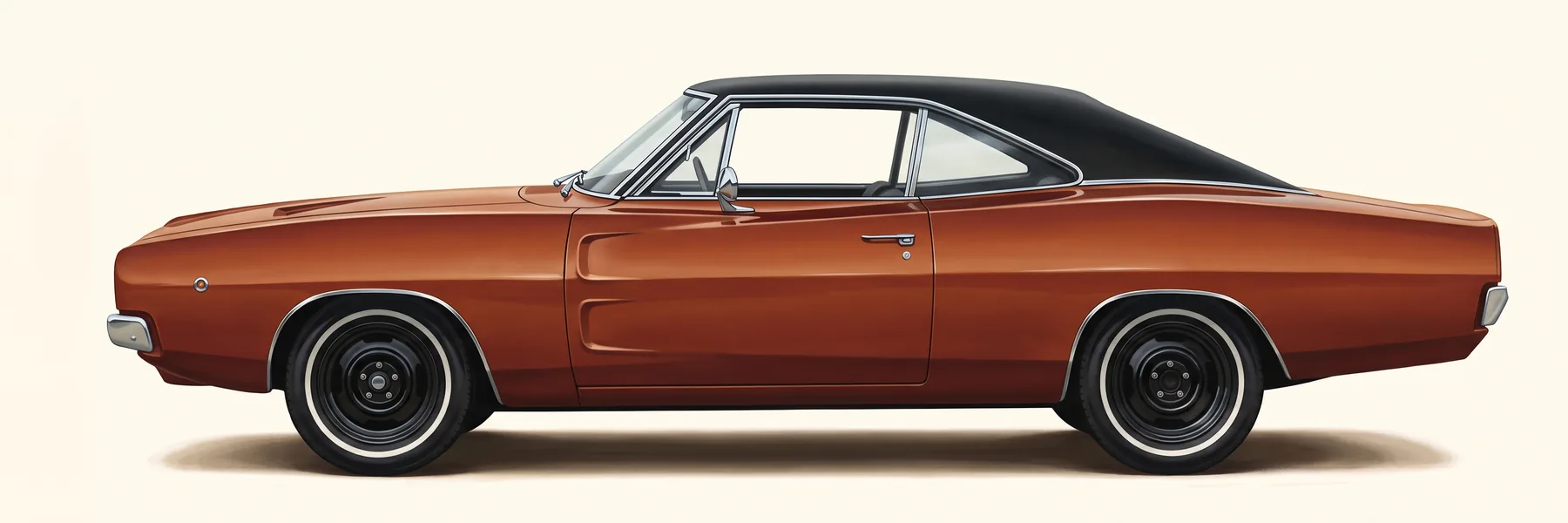
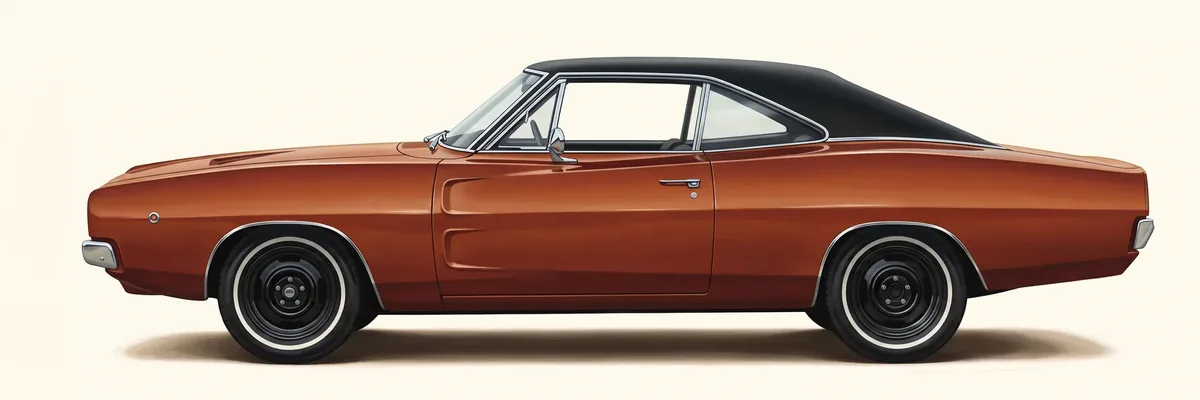
The 1968 from the side.The 1967, for comparison
A notchback with flying buttresses
The fastback is gone. The roof ends in a recessed rear window between two «flying buttress» sail panels.49
Two round tail lamps on each side
The full-width tail lamp of 1966–67 gave way to two round lamps on each side.29
Coke-bottle sides
The body curves out over the front and rear wheels.239
Vacuum headlamp doors
The headlamps still hide behind the full-width grille, but a vacuum-operated cover replaced the rotating lamps.23
VIN on the dash
The VIN plate moved from the door pillar to the left top of the dash, visible through the windshield.513one source
Over-Drive and Wikipedia give 96,100 for the Charger and R/T together, without a split. Consumer Guide counts 17,665 R/Ts; it also gives two different totals, 96,108 and 92,590. See the ruling.
B225 cu in slant six1-barrel (from the middle of the model year)145 hp
F318 cu in V82-barrel (standard until the six arrived)230 hp
G383 cu in V82-barrel290 hp
H383 cu in V84-barrel330 hp
K or L440 cu in Magnum V84-barrel (standard on the R/T)375 hp
J426 cu in Hemi V8two 4-barrels425 hp
The code is the engine letter in the VIN. Dodge's tables have two 440 codes, K (440) and L (440, high performance); none of our sources says which one the 440 Magnum carried, so both are given. The 225 six replaced the 318 as the standard engine in the middle of the 1968 model year.
17 factory colors. The color names are confirmed by two sources79; the swatches are approximate screen colors, not paint matches.
Dark BlueE
Bright BlueQ
Light BlueU
Dark TurquoiseL
Racing GreenG
Medium GreenT
Light GreenF
Medium GoldJ
Medium TanY
BeigeX
BronzeM
YellowS
BurgundyR
RedP
SilverA
WhiteW
BlackB
No source we have gives the number of cars per color, so the counts are left empty. The colors are those in Dodge's 1968 Charger catalog, 16 standard colors plus Silver at extra cost; the catalog adds «Metallic» to eleven of the 16 standard colors, and to Silver. The codes are from Over-Drive's list for all of Dodge's mid-size cars, which calls Dark Turquoise «Medium Dark Turquoise» and also has Pale Blue, Light Turquoise, Light Gold, Medium Blue (C), Charger Red (33) and Dark Green (66), none of them in the Charger catalog.
96,100 by the count we use: 96,100 hardtops. The sources disagree on the total; the ruling on this page explains which figure we show and why.1246sources disagree
How can you tell a 1968 Charger from a 1967?
Five signs, each explained under «How to spot» on this page: a notchback with flying buttresses; two round tail lamps on each side; coke-bottle sides; vacuum headlamp doors; VIN on the dash.2345913
What engines did the 1968 Dodge Charger have?
Six engines, from the 225 cu in slant six to the 426 cu in Hemi V8. The engine table on this page gives every code and rating, and the rulings cover the disputed ones.234511
How much did a 1968 Dodge Charger cost new?
Base retail prices, before options: Charger, six-cylinder $3,014; Charger, V8 $3,095; R/T $3,480.16
What colors did the 1968 Dodge Charger come in?
Dodge Division, Chrysler Corporation lists 17 factory colors.7one source
Where is the VIN on a 1968 Dodge Charger?
On a plate on the left top of the dash, visible through the windshield.35