
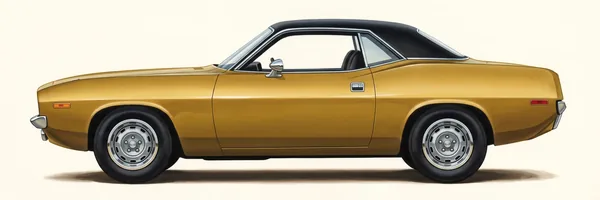
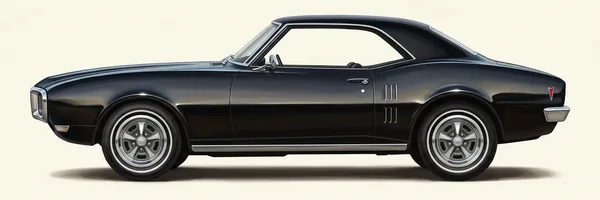
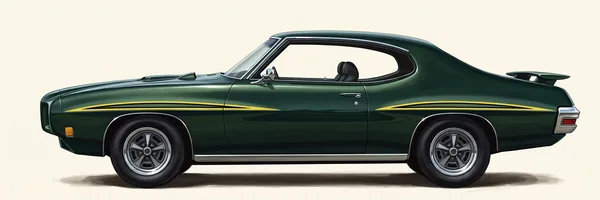
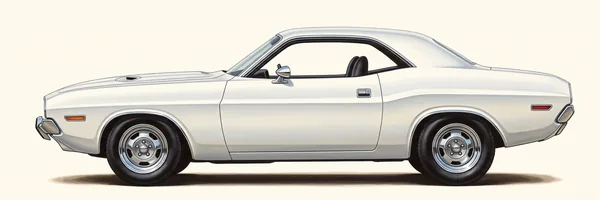
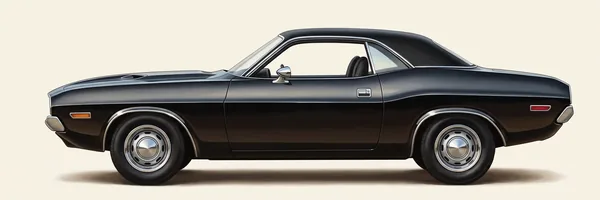
A two-piece grille insert
A one-piece grille frame holds a two-piece insert (Wikipedia calls it a «split» grille), black on the R/T and silver on the others.16
Pick a model
Chevrolet
Dodge
Ford
Plymouth
Pontiac
Dodge Challenger first generation · 1970–1974
Colors and paint codes
Class of '71 · Dodge Challenger · 1970–1971 body · first generation
The second year: a split grille, a cheaper Coupe with fixed rear side glass, the R/T as a hardtop only, and sales down to 29,883.
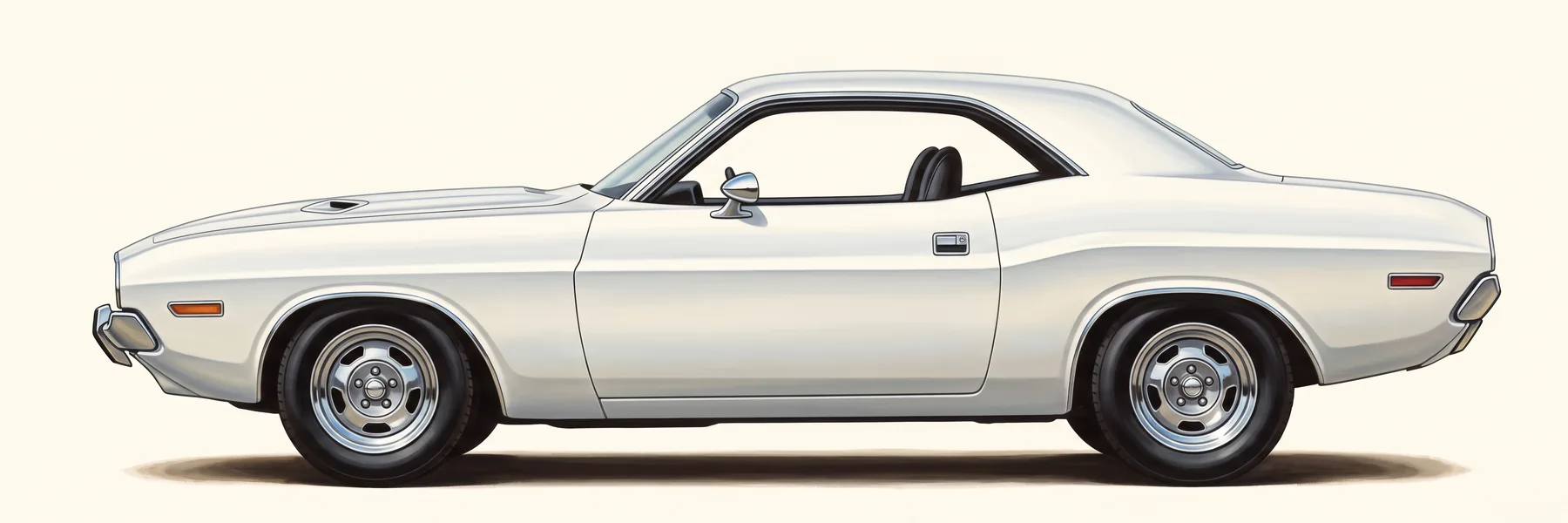
Sales fell to 29,883, down by more than 60 percent. The whole pony-car market was shrinking under new safety and emissions rules, after insurance surcharges had already hit high-powered cars in 1970.14
New at the bottom of the range was a coupe with fixed rear side glass and the 198 slant six. Dodge's catalog calls it the Challenger Coupe; Consumer Guide calls it the Deputy.13sources disagree
The R/T was now a hardtop only, with the 383 Magnum four-barrel as standard. Dodge quoted it at 300 hp gross and 250 hp net, and printed both ratings for every engine.13
Compression went down on most engines, by Dodge's 1970 and 1971 catalogs. The four-barrel 383s were retuned to run on regular fuel, the 383 Magnum from 9.5:1 to 8.5:1, while the 340, the 440 Six Pack and the Hemi still called for premium. The Hemi was barely changed, from 10.25:1 to 10.2:1.356
The story of the year
Four Dodge dealers supplied Challengers for the 1971 Indianapolis 500. According to a former owner of a replica, quoted by Consumer Guide, 50 Hemi Orange convertibles with white interiors were prepared for the pre-race festivities.1one source
On the parade lap the pace car, full of dignitaries, skidded as it left the track and crashed into a press box, injuring several reporters. Consumer Guide is our only source for the story.1one source
What tells it apart from a 1970.
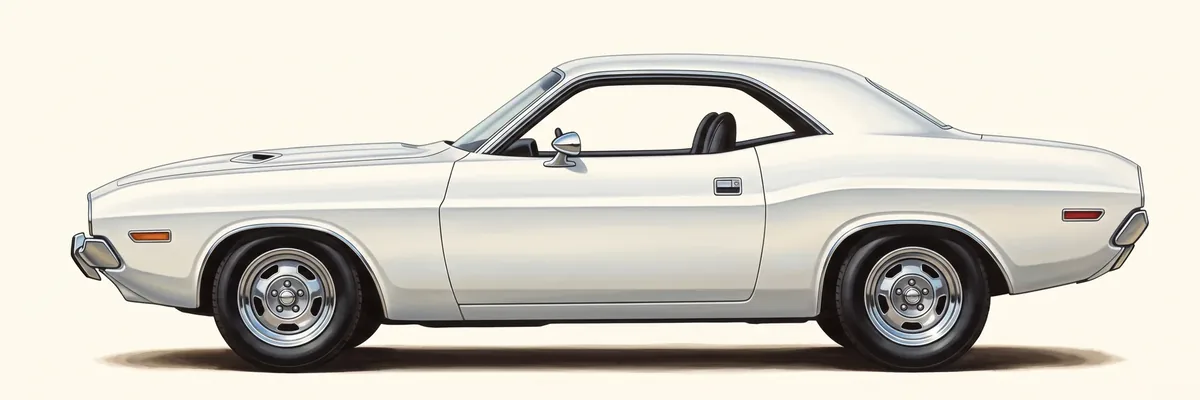
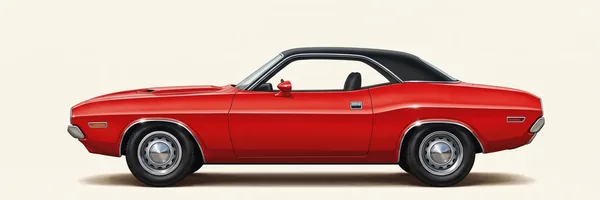
A one-piece grille frame holds a two-piece insert (Wikipedia calls it a «split» grille), black on the R/T and silver on the others.16
The backup lights sit at the left and right of the tail-lamp panel instead of in the middle.6one source
The R/T has simulated brake cooling slots on the rear quarters and large R/T lettering in its stripes.1one source
29,883 cars, by body.
| Body | Trim | Built |
|---|---|---|
| Coupe and hardtop | Challenger | 23,088 |
| All coupe and hardtops | 23,088 | |
| Convertible | Challenger | 2,165 |
| All convertibles | 2,165 | |
| Hardtop | R/T | 4,630 |
| All hardtops | 4,630 | |
| Total | 29,883 | |
Consumer Guide's table, and Over-Drive's, which shares its rows: 23,088 coupes and hardtops together, 2,165 convertibles and 4,630 R/Ts. Wikipedia's uncited rows give 26,299. See the ruling.
8 engines. The letter is the engine code in the VIN.
Gross and net horsepower from Dodge's 1971 catalog (Canadian edition), which prints both. Wikipedia gives the same figures except for the 440 Six Pack, 340 net against the catalog's 330. Dodge's (Canadian) 1971 catalog lists no 440 Magnum four-barrel, and Over-Drive says the T/A's 340 Six Pack was not offered for 1971.
Base retail prices in 1971 dollars, before options.
From Over-Drive's table; J.D. Power gives the same $2,950 for the V8 hardtop and $3,273 for the R/T. Consumer Guide calls $2,727 the price of the standard hardtop, which is Over-Drive's price for the coupe; see the ruling.
22 factory colors. 5 of the 22 color names are confirmed by a second source34; the swatches are approximate screen colors, not paint matches.
No source we have gives the number of cars per color, so the counts are left empty. The 22 names and codes are Over-Drive's; its list has two «Dark Green» codes, F7 and F8. Dodge's Canadian 1971 catalog names Plum Crazy, Green Go, Tor-Red, Butter Scotch and Citron Yella as extra-cost colors; Over-Drive's list has no Tor-Red.
A 1971 VIN has 13 characters. Type one in, and the decoder reads it against the code tables on this page.
JS23N1B1000017910 · An example built from the code tables on this page, not a real car's VIN: R/T, 383 Magnum, 1971, Hamtramck, unit 100001. None of our sources prints a real Challenger VIN.
| Position | Meaning |
|---|---|
| J | Car line: Dodge Challenger |
| H · L · S | Price class: Coupe, hardtop and convertible (Over-Drive's table) · Coupe and hardtop (Over-Drive's text) · R/T |
| 21 · 23 · 27 | Body: 2-door coupe (fixed rear side glass) · 2-door hardtop · convertible |
| B · C · G · H · L · N · R · V | Engine (see the engine table) |
| 1 | Model year (1971) |
| A · B · C · D · E · F · G · R | Assembly plant (tpocr's table of Dodge's codes) |
| 100001 → | Sequential unit number |
Where to find it: On a plate on the left top of the dash, visible through the windshield.710
29,883 by the count we use: 23,088 coupe and hardtops, 2,165 convertibles, 4,630 hardtops. The sources disagree on the total; the ruling on this page explains which figure we show and why.1246sources disagree
Three signs, each explained under «How to spot» on this page: a two-piece grille insert; backup lights at the sides; R/T: slots on the rear quarters.16
Eight engines, from the 198 cu in slant six to the 426 cu in Hemi V8. The engine table on this page gives every code and rating, and the rulings cover the disputed ones.13467
Base retail prices, before options: Coupe, six-cylinder $2,727; Coupe, V8 $2,853; Hardtop, six-cylinder $2,848; Hardtop, V8 $2,950; Convertible, six-cylinder $3,105; Convertible, V8 $3,207; R/T hardtop $3,273.128one source
Over-Drive Magazine lists 22 factory colors.4one source
Every conflict we found for 1971, and how we settled it. All rulings.
Open
Our ruling: Unresolved. We show 29,883 from Consumer Guide's table. Over-Drive's table gives the same rows, but it shares Consumer Guide's rows (in 1970 its R/T hardtop row is Consumer Guide's R/Ts plus its T/As, and both group the 1971 coupe and hardtop as 23,088), so it is not a second witness. Against Wikipedia's uncited 26,299 that is one source against one, as in 1972–74.
Open
Our ruling: Unresolved. Dodge's 1971 catalog calls the cheapest 1971 car the Challenger Coupe and does not use the name Deputy. Wikipedia puts the Deputy in the middle of 1970, Consumer Guide in 1971, and Over-Drive's 1970 table has no coupe row. We describe the 1971 car under the catalog's name.
Open
Our ruling: Unresolved, but we show Over-Drive's rows: J.D. Power's $2,950 for the V8 hardtop matches them (its prices follow Over-Drive's table, so it is not a second witness), and Consumer Guide's $2,727, which it calls the standard hardtop's price, is Over-Drive's coupe price.
Open
Our ruling: Unresolved. Consumer Guide calls the SE a package in 1971, limited to base models; Over-Drive says it was dropped as a separate model and its pieces became options; only Wikipedia calls it 1970-only, citing a 1970 brochure. A package gets no row of its own in Consumer Guide's table, so the missing row settles nothing. We list no 1971 SE.
Settled
Our ruling: Yes, on most engines. Dodge's own catalogs give the 383 Magnum 9.5:1 in 1970 and 8.5:1 in 1971, the two-barrel 383 8.7:1 and 8.5:1, the 318 8.8:1 and 8.6:1, the 440 Six Pack 10.5:1 and 10.3:1, and the Hemi 10.25:1 and 10.2:1, so Consumer Guide's sentence is wrong for the Challenger. The 1970 catalog's figure for the 340 reads 8.8:1, against the 10.5:1 that Over-Drive and Wikipedia give, so the 340 is left out of the comparison.
Open
Our ruling: Unresolved: Over-Drive's table and its own text disagree, and we have no other source. The decoder shows both.
Open
Our ruling: Unresolved. The archived page has lost the table's layout, so it does not show which engine heading has no figures, and we give no 1971 Hemi count.
Settled
Our ruling: We use Dodge's own 1971 catalog, which Over-Drive's 1970 figures match: 191.3 by 76.1 inches, 50.9 high. Wikipedia's infobox has no citation, and Consumer Guide's figures describe the car as planned.
Open
Our ruling: Unresolved, and it does not matter much for the Challenger, which no source we have places in Windsor. We show R, as two of the three tables do.
Keep going
1970Dodge ChallengerThe first Challenger: Dodge's E-body pony car, as a hardtop or convertible, with the R/T, the SE and the T/A, nine engines up to the 426 Hemi, and about 83,000 built.83,032 built (disputed)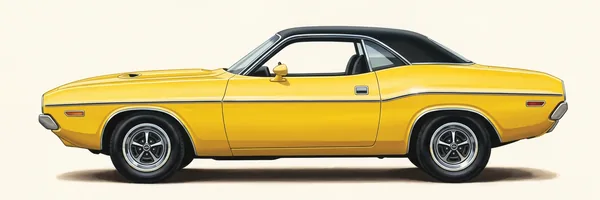 1972Dodge ChallengerA hardtop only, the R/T replaced by the Rallye, no big-block engines, and the «sad mouth» grille.26,663 built (disputed)
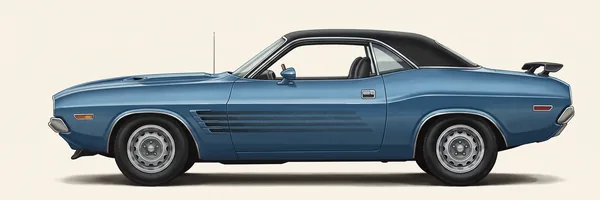 1973Dodge ChallengerFive-mph bumpers, the six-cylinder dropped, the Rallye turned into a package, and sales up to about 32,600.32,596 built (disputed)
Dimensions, production year by year and every ruling, 1970–1974.