
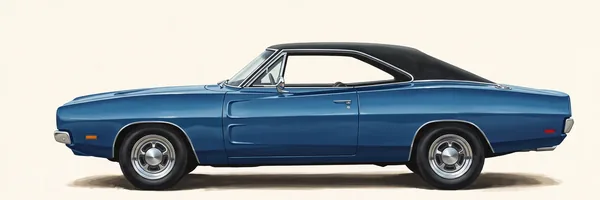
A divided grille
A vertical divider splits the grille in the middle; the 1968 grille is one piece.167
Pick a model
Chevrolet
Dodge
Ford
Plymouth
Pontiac
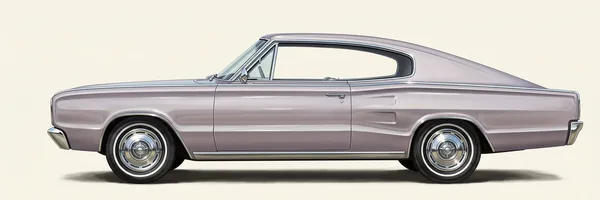
Dodge Charger two generations · 1966–1970
First generation · 1966–1967
Second generation · 1968–1970
Colors and paint codes
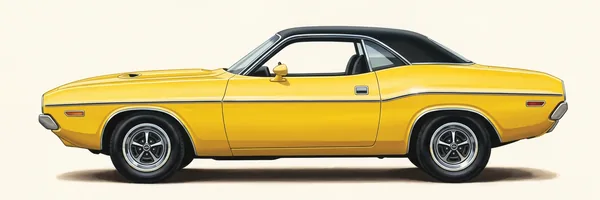
Class of '69 · Dodge Charger · 1968–1969 body · second generation
A divided grille, new tail lamps and the SE, plus two cars built for NASCAR: the Charger 500 and the winged Daytona.
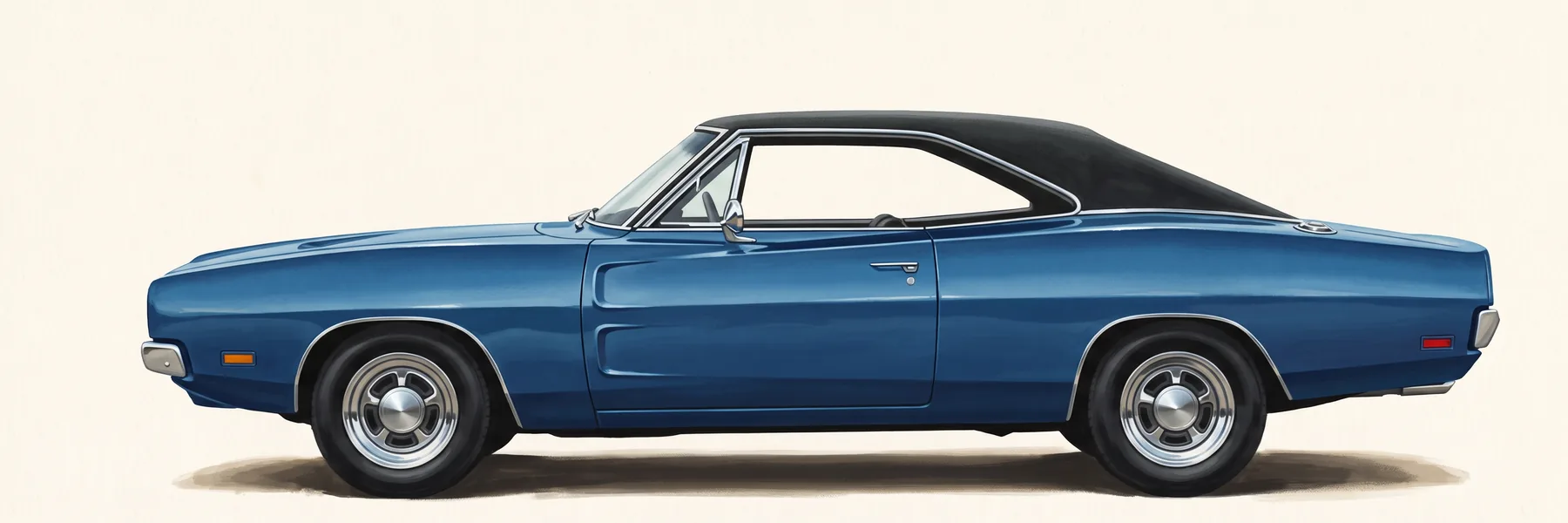
Dodge built 89,199 Chargers for 1969, almost as many as in 1968.12
The body was carried over. The grille gained a centre divider and the tail lamps became long units across the back.127
A new SE, for Special Edition, added leather-and-vinyl front buckets, wood-grain trim and turn signals on the hood. It could be ordered alone or on an R/T.157
The story of the year
The 1968 Charger lost to Ford on the fast ovals: wind-tunnel tests showed that the tunnelled rear window made lift and the open grille made drag. The Charger 500 got a flush rear window and a flush grille.127
It was not enough, so Dodge followed with the Charger Daytona, introduced on 13 April 1969, with a nose cone and a 23-inch wing on the rear deck.178
503 Daytonas were built for sale in the United States.1one source
What tells it apart from a 1968.
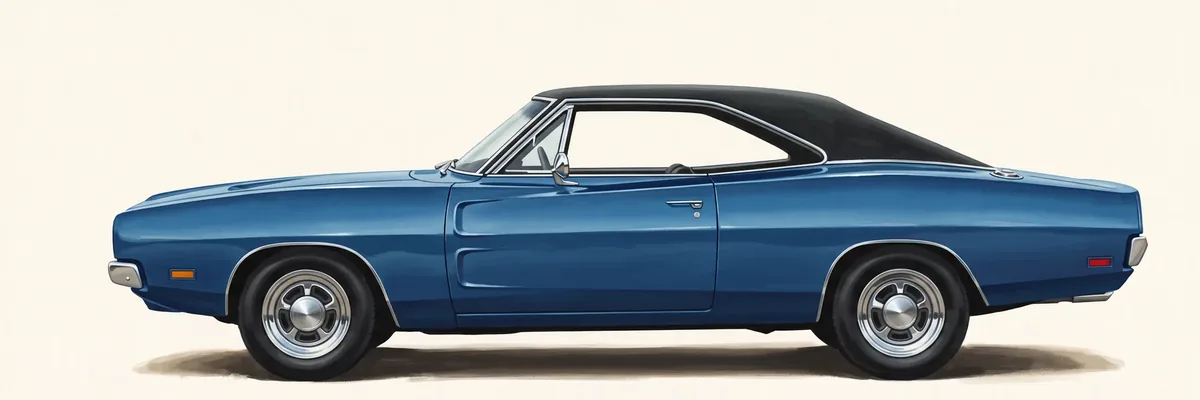
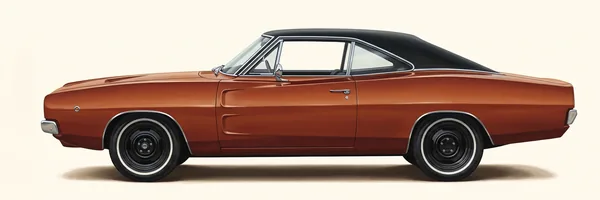
89,199 cars, by body.
| Body | Trim | Built |
|---|---|---|
| Hardtop | Charger (no split by model) | 89,199 |
| All hardtops | 89,199 | |
| Total | 89,199 | |
Wikipedia and Hagerty give 89,199. Over-Drive's table splits the year, rounded to the hundred, into 69,100 Chargers and Charger 500s and 20,100 R/Ts, which add up to 89,200 (our sum).
6 engines. The letter is the engine code in the VIN.
The code is the engine letter in the VIN. Dodge's tables have two 440 codes, K (440) and L (440, high performance); none of our sources says which one the 440 Magnum carried, so both are given. The 440 Six Pack is not listed: three sources say it came for 1970; see the ruling.
Base retail prices in 1969 dollars, before options.
From Over-Drive's table, where the row is labelled «Charger SE/500»; Consumer Guide gives the same $3,860 for the Charger 500. The Daytona's price is disputed; see its page.
18 factory colors. 17 of the 18 color names are confirmed by a second source57; the swatches are approximate screen colors, not paint matches.
No source we have gives the number of cars per color, so the counts are left empty. The 18 colors are those in Dodge's 1969 Charger catalog; the codes are from Over-Drive's list for all of Dodge's mid-size cars. Over-Drive has no Bright Red for 1969, so that code is left empty; its list has a Charger Red (R4), which no source we have ties to the catalog's Bright Red.
A 1969 VIN has 13 characters. Type one in, and the decoder reads it against the code tables on this page.
XX29J9B10000123 · An example built from the code tables on this page, not a real car's VIN: Charger 500 or Daytona, Hemi, 1969, Hamtramck, unit 100001. None of our sources prints a real Charger VIN.
| Position | Meaning |
|---|---|
| X | Car line: Dodge Charger |
| P · S · X | Price class: Charger · Charger R/T · Charger 500 or Daytona |
| 29 | Body: 2-door sports hardtop |
| B · F · G · H · J · K · L · M | Engine (see the engine table) |
| 9 | Model year (1969) |
| A · B · C · D · E · F · G · R · P | Assembly plant (Dodge's code table) |
| 100001 → | Sequential unit number |
Where to find it: On a plate on the left top of the dash, visible through the windshield.23
Dodge built 89,199 for the 1969 model year: 89,199 hardtops.124
Two signs, each explained under «How to spot» on this page: a divided grille; long tail lamps.1267
Six engines, from the 225 cu in slant six to the 426 cu in Hemi V8. The engine table on this page gives every code and rating, and the rulings cover the disputed ones.123569
Base retail prices, before options: Charger, six-cylinder $3,020; Charger, V8 $3,125; Charger 500 $3,860; R/T $3,592.46
Dodge Division, Chrysler Corporation lists 18 factory colors.5one source
Every conflict we found for 1969, and how we settled it. All rulings.
Settled
Our ruling: We use 89,199, which Wikipedia and Hagerty give; Hagerty may have it from Wikipedia, and neither cites a source. Over-Drive's rows, rounded to the hundred, add up to 89,200, which agrees with it but can only confirm the total to within about 100. Consumer Guide's rough figures do not contradict it.
Settled
Our ruling: No. Wikipedia and Consumer Guide say the Six Pack came to the Charger for 1970. Hagerty contradicts itself, calling it a 1970-only engine and also available from the start. Over-Drive's own 1969 summary names the Six Pack as a Super Bee novelty, so its 1969 Charger price is most likely a slip.
Open
Our ruling: Unresolved: $4,000 or $5,903. Neither figure is cited, and the gap is too big to be options. We give no price.
Open
Our ruling: Unresolved. Wikipedia's 1969 sunroof and its 260 cars have no citation; Consumer Guide calls the 1970 electric sunroof a first, and the 1970 catalog lists it. We do not use the 260.
Settled
Our ruling: We use Dodge's own catalogs for both years: 208.0 × 76.6 × 53.2 inches. Wikipedia and Over-Drive give 76.7 for the width, and Over-Drive 207.0 for the 1969 length. For 1969 Over-Drive gives the height as 53.0 inches, or 53.5 with the 318.
Settled
Our ruling: Letters. The Plymouth Owners Club registry gives letters for 1968–69 and Hagerty calls the seventh character a letter; only one guide gives digits. The same guide gives T for Windsor in 1970, where two others give R.
Keep going
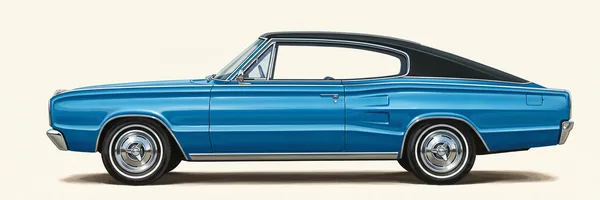 1967Dodge ChargerThe fastback's second and last year: turn signals on the fenders, a vinyl roof, the 440 Magnum, and only 15,788 built.15,788 built1968Dodge ChargerAn all-new coke-bottle Charger with a flying-buttress roof, the first R/T, and sales of about 96,100.96,100 built (disputed)
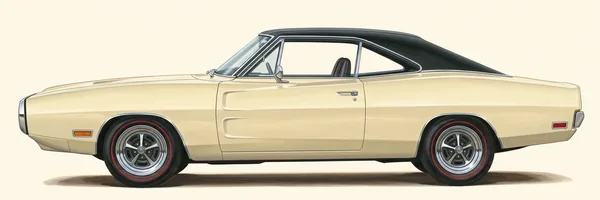 1970Dodge ChargerThe last of the second generation: a chrome loop bumper, High Impact colors, the 440 Six Pack, and falling sales.49,768 built (disputed)
Dimensions, production year by year and every ruling, 1968–1970.