
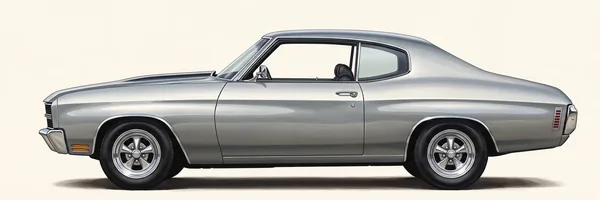
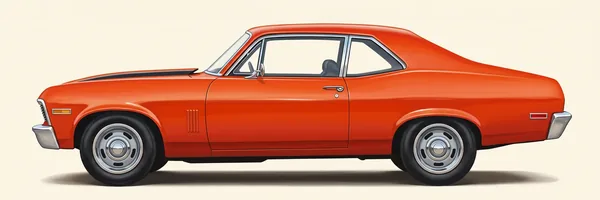
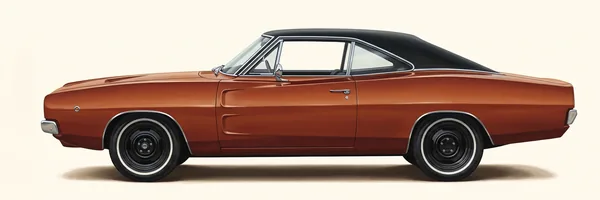
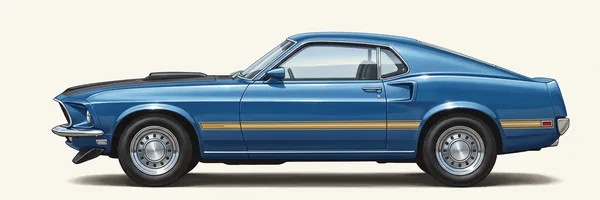
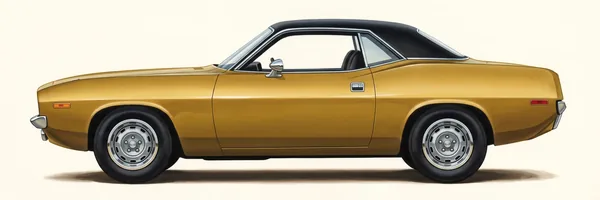
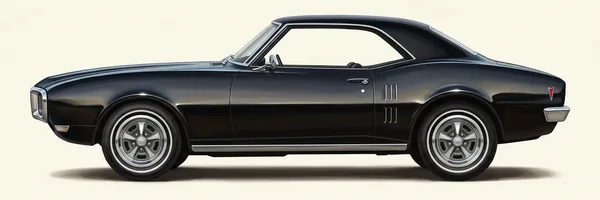
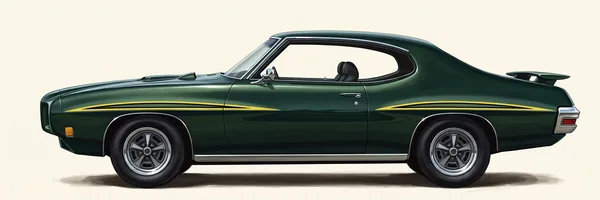
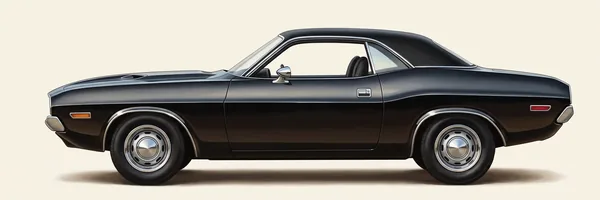
Full-width tail lamps
The tail lamps run across the whole rear panel, with the backup light in the middle. On the 1971 the backup lights sit left and right.4one source
Pick a model
Chevrolet
Dodge
Ford
Plymouth
Pontiac
Dodge Challenger first generation · 1970–1974
Colors and paint codes
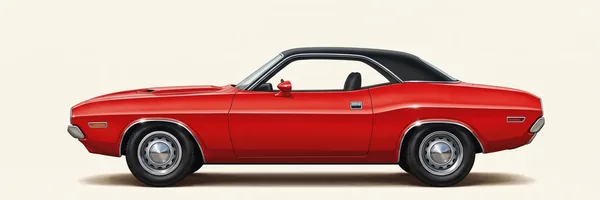
Class of '70 · Dodge Challenger · 1970–1971 body · first generation
The first Challenger: Dodge's E-body pony car, as a hardtop or convertible, with the R/T, the SE and the T/A, nine engines up to the 426 Hemi, and about 83,000 built.
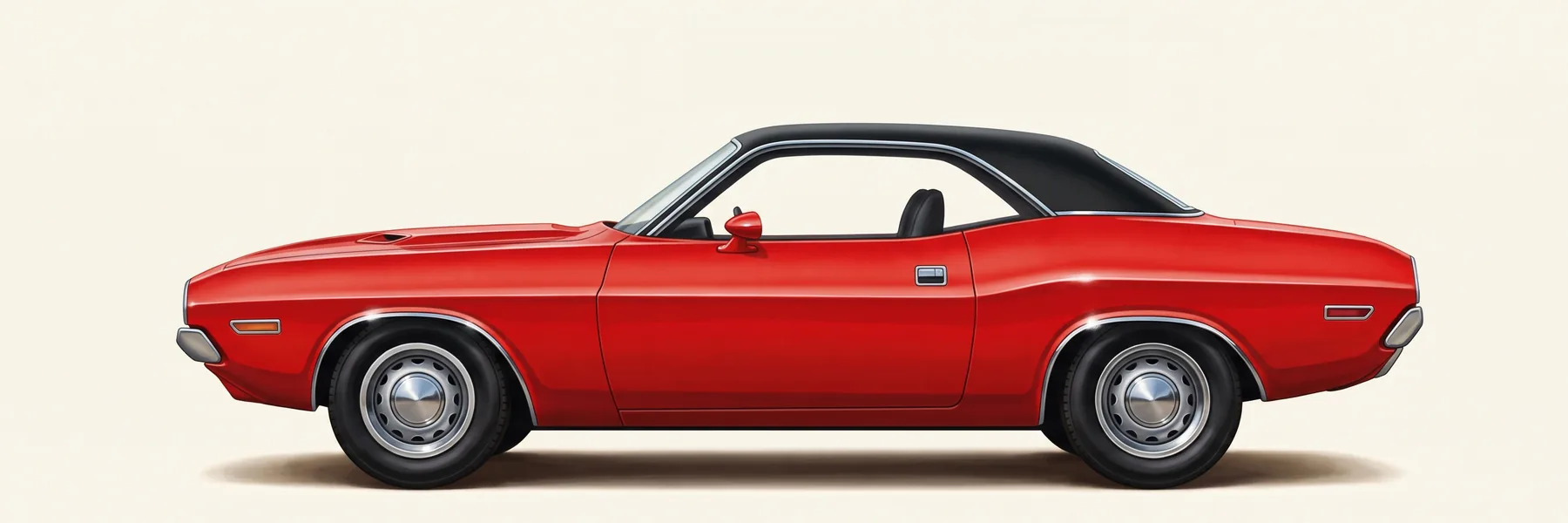
Dodge started its pony car in late 1966, after Chrysler's executives had seen Mercury's Cougar: a longer, plusher pony aimed at the same buyers as Dodge. The Challenger shared its new E-body with the 1970 Barracuda but rode on a wheelbase two inches longer, 110 inches.1one source
It came as a hardtop or a convertible, each as a standard Challenger or an R/T, and either hardtop could have the Special Edition package with a vinyl roof and a smaller rear window.123
The standard engine was the 225 slant six with 145 hp; the base V8 was the 318. Above them came the 340, three 383s, two 440s and the 426 Hemi: nine engines in all, more than any other Dodge that year, by Dodge's own catalog. The T/A's 340 Six Pack came on top of the catalog's nine.134
Consumer Guide puts the year's production at 83,032, ahead of the Cougar's 72,000 or so. The sources disagree: Wikipedia gives 76,935 and Over-Drive 85,431.124sources disagree
The story of the year
Dodge entered the SCCA's Trans-American series in 1970 with a Challenger prepared by Ray Caldwell's Autodynamics for Sam Posey. The street T/A followed in the spring of 1970 to meet the rule that the racer had to be sold to the public.14
The team managed a few top-three finishes but was no match for the Mustangs and Penske's Javelins, and Dodge left the series after one season.14
Who drew the car is disputed. Consumer Guide says the design that won was Bill Brownlie's own, made at the last minute from his sketches; Wikipedia credits Carl Cameron, who drew the 1966 Charger.14
What tells it apart from a 1971.
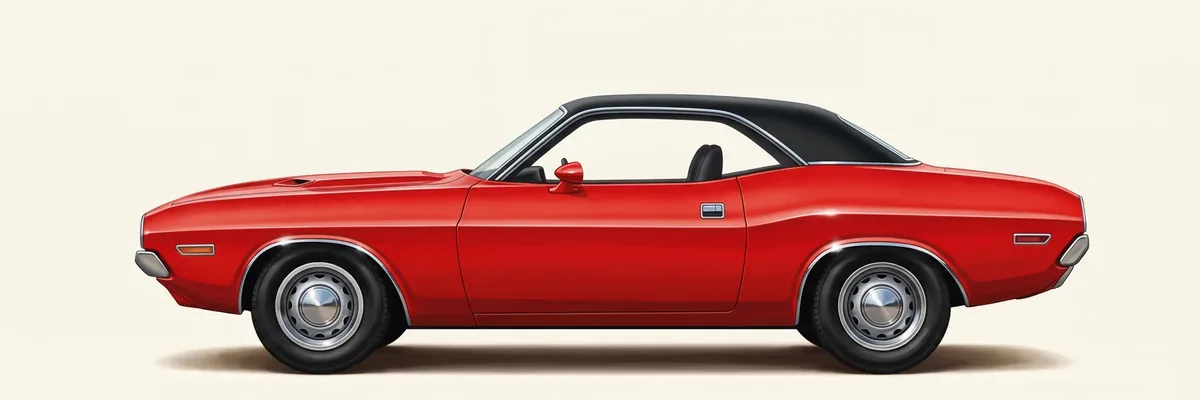
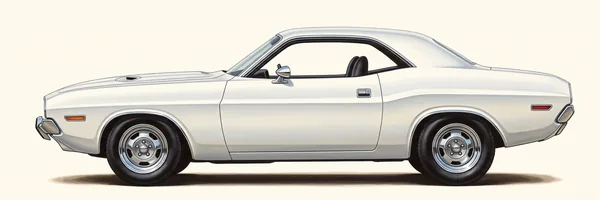
The tail lamps run across the whole rear panel, with the backup light in the middle. On the 1971 the backup lights sit left and right.4one source
The grille is a set-back «venturi» opening that runs the full width of the car. On the 1971 a grille frame holds a two-piece insert.15
The R/T came as a convertible only in 1970; for 1971 the R/T was a hardtop only.16
The T/A, with its scooped fiberglass hood and side-exit exhausts, was built only for 1970. A 1971 T/A appeared in advertising but was never built.16
83,032 cars, by body.
| Body | Trim | Built |
|---|---|---|
| Hardtop | Challenger | 53,337 |
| Challenger SE | 6,584 | |
| R/T | 12,747 | |
| R/T SE | 3,979 | |
| T/A | 2,142 | |
| All hardtops | 78,789 | |
| Convertible | Challenger | 3,173 |
| R/T | 1,070 | |
| All convertibles | 4,243 | |
| Total | 83,032 | |
Rows from Consumer Guide's table (from Langworth's Encyclopedia of American Cars, 1984), the only rows with a named source. Over-Drive's table, which shares Consumer Guide's rows, adds up too (63,094 + 19,938 + 2,399 = 85,431), but by our arithmetic its 14,889 R/T hardtops are Consumer Guide's 12,747 plus its 2,142 T/As, so with its own 2,399-car T/A row the T/A looks counted twice. Wikipedia's uncited rows add to 77,075 (our sum), not its own total of 76,935; they reach 76,935 only if the T/A row is 2,399 instead of the 2,539 it prints. See the ruling.
10 engines. The letter is the engine code in the VIN.
Gross horsepower, as Dodge rated it in 1970. The code is the engine letter in the VIN. tpocr's table of Dodge's codes has one four-barrel 383 code, N («Hi. perf.»), and two 440 four-barrel codes, T and U; only Wikipedia's uncited table assigns them, N to both four-barrel 383s and U to the 440 Magnum, and we follow it. Wikipedia says the 440s and the Hemi were for the R/T only; Consumer Guide says the 440 was optional across the board.
Base retail prices in 1970 dollars, before options.
From Over-Drive's table. Consumer Guide gives the same $2,851 for the six-cylinder hardtop, and J.D. Power's price guide the same $2,953, $3,185, $3,266 and $4,056 for the V8 hardtop, the SE, the R/T and the T/A. Consumer Guide's T/A profile gives $4,480; see the ruling.
21 factory colors. 9 of the 21 color names are confirmed by a second source15; the swatches are approximate screen colors, not paint matches.
No source we have gives the number of cars per color, so the counts are left empty. Dodge's 1970 Challenger catalog has no color list, so the 21 names and codes are Over-Drive's. Consumer Guide counts 18 colors at launch, Panther Pink and Green Go added later; that makes 20, one fewer than Over-Drive's list (our count), and no source says which of the 21 is the odd one. Consumer Guide's «Top Banana» and «Sub Lime» are the High Impact names; Over-Drive lists Y1 as «Bright Yellow», and no Challenger source we have ties Top Banana to a code.
A 1970 VIN has 13 characters. Type one in, and the decoder reads it against the code tables on this page.
JS23R0B10000171011 · An example built from the code tables on this page, not a real car's VIN: R/T hardtop, Hemi, 1970, Hamtramck, unit 100001. None of our sources prints a real Challenger VIN.
| Position | Meaning |
|---|---|
| J | Car line: Dodge Challenger |
| H · S | Price class: Challenger (also the SE) · R/T (also the R/T SE) |
| 23 · 27 · 29 | Body: 2-door hardtop · convertible · 2-door sports hardtop (the SE, by Over-Drive's table) |
| C · G · H · J · L · N · R · T · U · V | Engine (see the engine table) |
| 0 | Model year (1970) |
| A · B · C · D · E · F · G · H · R | Assembly plant (tpocr's table of Dodge's codes) |
| 100001 → | Sequential unit number |
Where to find it: On a plate on the left top of the dash, visible through the windshield.711
83,032 by the count we use: 78,789 hardtops, 4,243 convertibles. The sources disagree on the total; the ruling on this page explains which figure we show and why.124sources disagree
Four signs, each explained under «How to spot» on this page: full-width tail lamps; a full-width grille; an R/T convertible on the list; the T/A.1456
Ten engines, from the 225 cu in slant six to the 426 cu in Hemi V8. The engine table on this page gives every code and rating, and the rulings cover the disputed ones.13457
Base retail prices, before options: Hardtop, six-cylinder $2,851; Hardtop, V8 $2,953; SE hardtop, six-cylinder $3,083; SE hardtop, V8 $3,185; Convertible, six-cylinder $3,120; Convertible, V8 $3,198; R/T hardtop $3,266; R/T SE hardtop $3,498; R/T convertible $3,535; T/A $4,056.1289one source
Over-Drive Magazine lists 21 factory colors.5one source
Every conflict we found for 1970, and how we settled it. All rulings.
Open
Our ruling: Unresolved. We show Consumer Guide's rows, the only set with a named source (Langworth's Encyclopedia of American Cars, 1984). Over-Drive's table shares those rows and adds up too, but not independently. By our arithmetic Over-Drive's 14,889 R/T hardtops are Consumer Guide's 12,747 plus its 2,142 T/As, and Over-Drive's 85,431 is Consumer Guide's total plus exactly its own 2,399-car T/A row, so the T/A looks counted twice. Wikipedia's uncited rows reach its total only if the T/A is 2,399, not the 2,539 its table prints. Consumer Guide's own engine table is not clean either: its R/T hardtop installations add to 13,333 (our sum), more than the 12,747 R/T hardtops in its production table. Wikipedia's figures are lower than Consumer Guide's in every year from 1970 to 1974, and no source explains why.
Open
Our ruling: Unresolved. Consumer Guide gives 2,142 in its main article and 2,539 in its T/A profile, which Wikipedia's table repeats (Wikipedia's T/A section cites that profile, so it is not a second source). Wikipedia's text and Over-Drive's production table give 2,399; Over-Drive's table is a separate document with price, weight and body code, though it shares Consumer Guide's other rows. Wikipedia's 1970 total only adds up with 2,399. The year page uses 2,142 so that its rows add up to Consumer Guide's total.
Open
Our ruling: Unresolved. We show $4,056 from Over-Drive's table; J.D. Power's price guide gives the same, but its 1970–71 prices match Over-Drive's table on every row, so the two are one chain. Consumer Guide's T/A profile gives $4,480 without saying what it includes.
Open
Our ruling: Unresolved: $1,227.50 or $871, and neither source says what the price includes. We give no Hemi price in the tables.
Open
Our ruling: Unresolved. Consumer Guide names its source; Wikipedia's sentence has no citation. Over-Drive repeats Wikipedia's sentence and is not counted.
Settled
Our ruling: We use Dodge's own 1971 catalog, which Over-Drive's 1970 figures match: 191.3 by 76.1 inches, 50.9 high. Wikipedia's infobox has no citation, and Consumer Guide's figures describe the car as planned.
Open
Our ruling: Unresolved. Dodge's 1971 catalog calls the cheapest 1971 car the Challenger Coupe and does not use the name Deputy. Wikipedia puts the Deputy in the middle of 1970, Consumer Guide in 1971, and Over-Drive's 1970 table has no coupe row. We describe the 1971 car under the catalog's name.
Open
Our ruling: Unresolved, and it does not matter much for the Challenger, which no source we have places in Windsor. We show R, as two of the three tables do.
Keep going
1971Dodge ChallengerThe second year: a split grille, a cheaper Coupe with fixed rear side glass, the R/T as a hardtop only, and sales down to 29,883.29,883 built (disputed)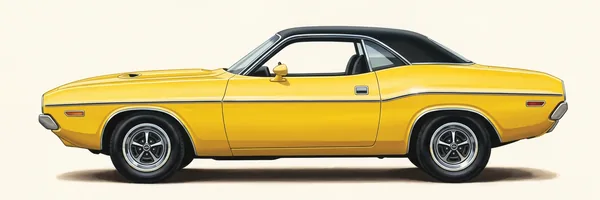 1972Dodge ChallengerA hardtop only, the R/T replaced by the Rallye, no big-block engines, and the «sad mouth» grille.26,663 built (disputed)
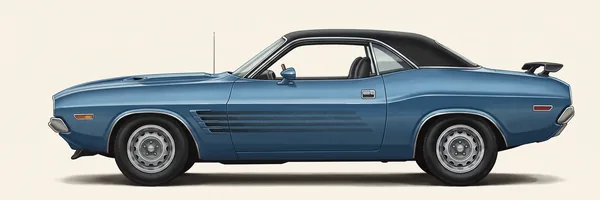 1973Dodge ChallengerFive-mph bumpers, the six-cylinder dropped, the Rallye turned into a package, and sales up to about 32,600.32,596 built (disputed)
Dimensions, production year by year and every ruling, 1970–1974.