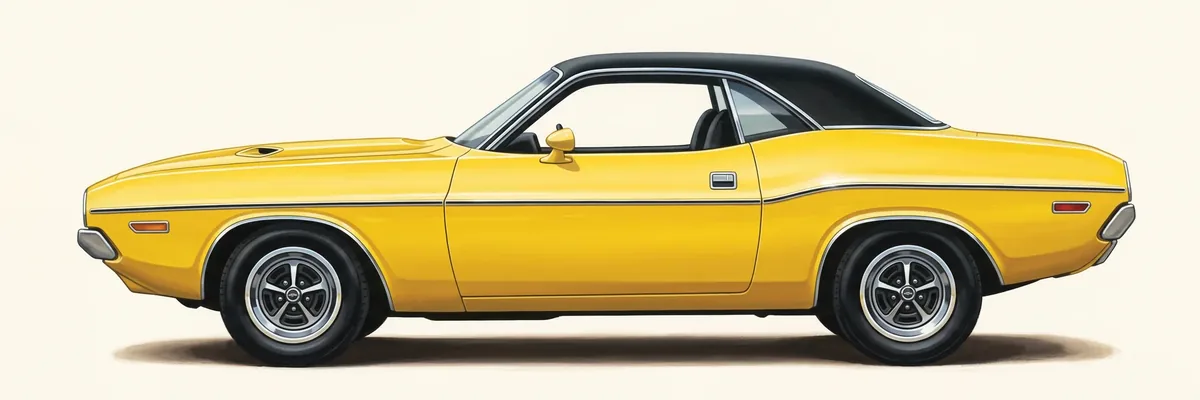
A 1972 VIN has 13 characters. Type one in, and the decoder reads it against the code tables on this page.
JH23G2B10000134 · An example built from the code tables on this page, not a real car's VIN: a 318 V8 hardtop, 1972, Hamtramck, unit 100001; the price-class H is one of Dodge's classes, used only to fill the position. None of our sources prints a real Challenger VIN.
The code table
Position
Meaning
J
Car line: Dodge Challenger
H · L · M · P · S
Price class: High · Low · Medium · Premium · Special (Dodge's classes for all its cars; which a Challenger used is not in our sources)
23
Body: 2-door hardtop
C · G · H
Engine (see the engine table)
2
Model year (1972)
A · B · C · D · F · G · R
Assembly plant (tpocr's table of Dodge's codes)
100001 →
Sequential unit number
Where to find it: On a plate on the left top of the dash, visible through the windshield.35
Our ruling: Unresolved. Neither Consumer Guide nor J.D. Power says which engine its base price assumes; in Over-Drive's 1970–71 tables the six-cylinder car is the cheapest, so presumably the same here (our inference). We show Consumer Guide's figure and give J.D. Power's in the note.
For 1972 Dodge cut much more than engines. Wikipedia says the option lists were drastically trimmed: most interior upgrades went, leather seats among them, and so did power windows and power seats, while a sunroof became available. All performance axle ratios disappeared except a 3.55 Sure-Grip, which came only with the 340 and the heavy-duty suspension. The 340 was also the only engine that could be had with a four-speed, and Wikipedia's table rates it at 240 hp net on 8.5:1 compression. Consumer Guide describes a car that looked more than ever like a child of the 1960s, and says Dodge quietly admitted it was fading by giving it little promotion. From 1972, in Consumer Guide's view, Dodge carried the Challenger almost as an afterthought, with no push on either performance or luxury.16
The convertible, the Scat Pack and every big-block engine were gone. What was left was a standard hardtop and a sportier Rallye, which replaced the R/T.12
Three engines remained: the 225 six (not on the Rallye), the 318, and a new low-compression 340 with dual exhausts as the one option.12
By Wikipedia's account all three engines were detuned to run on lead-free gasoline, and ratings were now SAE net figures.6one source
The base hardtop listed at $2,790 and the Rallye at about $300 more, by Consumer Guide; J.D. Power's price guide gives $2,902 and $3,082. Sales held almost steady at 26,663, though Wikipedia counts only 22,919.167sources disagree
The story of the year
«Not the world's hottest car»
Dodge sold the Rallye almost apologetically. Its 1972 catalog says: «The way things are today, maybe what you need is not the world's hottest car. Maybe what you need is a well-balanced, thoroughly instrumented road machine.»12
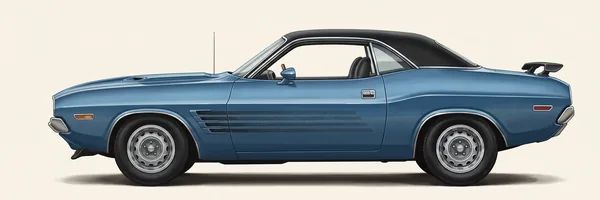
The Rallye had simulated air extractors on the front fenders with black stripes running back from them, a performance hood with scoops, F70 x 14 tires and the Rallye instrument cluster.12
How to spot a 1972
What tells it apart from a 1971.
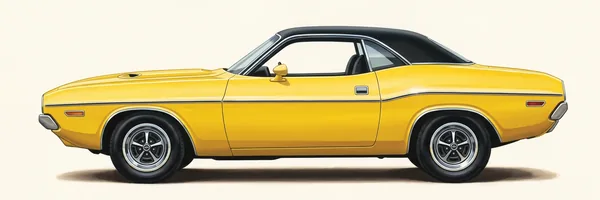
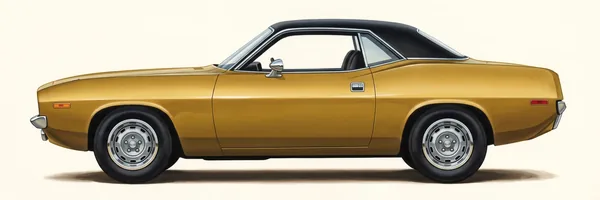
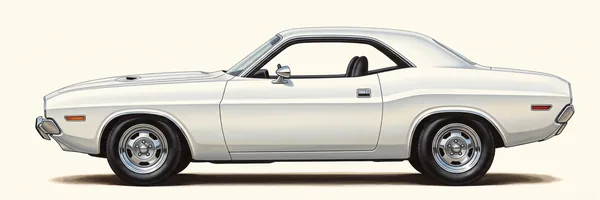
The 1972 from the side.The 1971, for comparison
The «sad mouth» grille
The grille is an egg-crate that extends below the front bumper.16
Four tail lamps
Four separate rectangular tail lamps, with the backup lights in the inner pair.16
C225 cu in slant six (not on the Rallye)110 hp net
G318 cu in V82-barrel (standard on the Rallye)155 hp net
H340 cu in V84-barrel240 hp net
Net horsepower. Dodge's 1972 catalog gives no ratings, so they are Wikipedia's, from an uncited table that groups the 1971 and 1972 ratings of both the 225 and the 318 under one figure. The code is the engine letter in the VIN.
Base retail prices in 1972 dollars, before options.
1972 Challenger · price when new
Hardtop$2,790
Rallyeabout $300 more
Consumer Guide's figures. J.D. Power's price guide gives $2,902 for the hardtop and $3,082 for the Rallye and does not say which engine the hardtop price assumes; see the ruling.
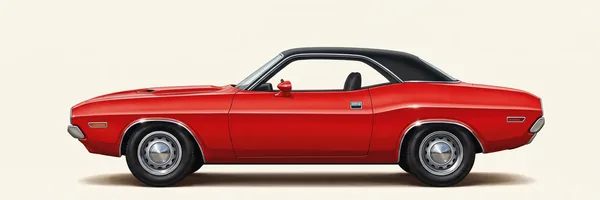
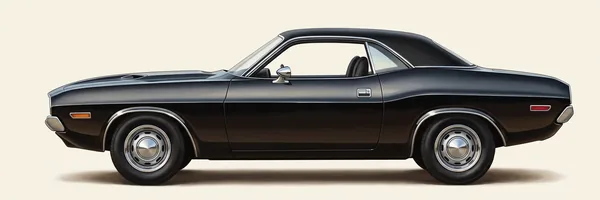
16 factory colors. The color names come from one source2one source; the swatches are approximate screen colors, not paint matches.
Light Blue—
Bright Blue Metallic—
Red—
Light Green Metallic—
Dark Green Metallic—
Eggshell White—
Black—
Light Gold—
Gold Metallic—
Dark Gold Metallic—
Dark Tan Metallic—
Light Gunmetal Metallic—
Medium Tan Metallic—
Super Blue—
Hemi Orange—
Top Banana—
No source we have gives the number of cars per color, so the counts are left empty. The 16 colors are those in Dodge's 1972 Challenger catalog, which prints no codes; Hemi Orange and Top Banana are its two High Impact colors at extra cost.
26,663 by the count we use: 26,663 hardtops. The sources disagree on the total; the ruling on this page explains which figure we show and why.16sources disagree
How can you tell a 1972 Challenger from a 1971?
Four signs, each explained under «How to spot» on this page: the «sad mouth» grille; four tail lamps; no convertible; rallye badges instead of R/T.168
What engines did the 1972 Dodge Challenger have?
Three engines, from the 225 cu in slant six (not on the Rallye) to the 340 cu in V8. The engine table on this page gives every code and rating, and the rulings cover the disputed ones.1236
How much did a 1972 Dodge Challenger cost new?
Base retail prices, before options: hardtop $2,790; Rallye about $300 more.17one source
What colors did the 1972 Dodge Challenger come in?
Dodge Division, Chrysler Corporation lists 16 factory colors.2one source
Where is the VIN on a 1972 Dodge Challenger?
On a plate on the left top of the dash, visible through the windshield.35